What Is Degenerative Disc Disease?
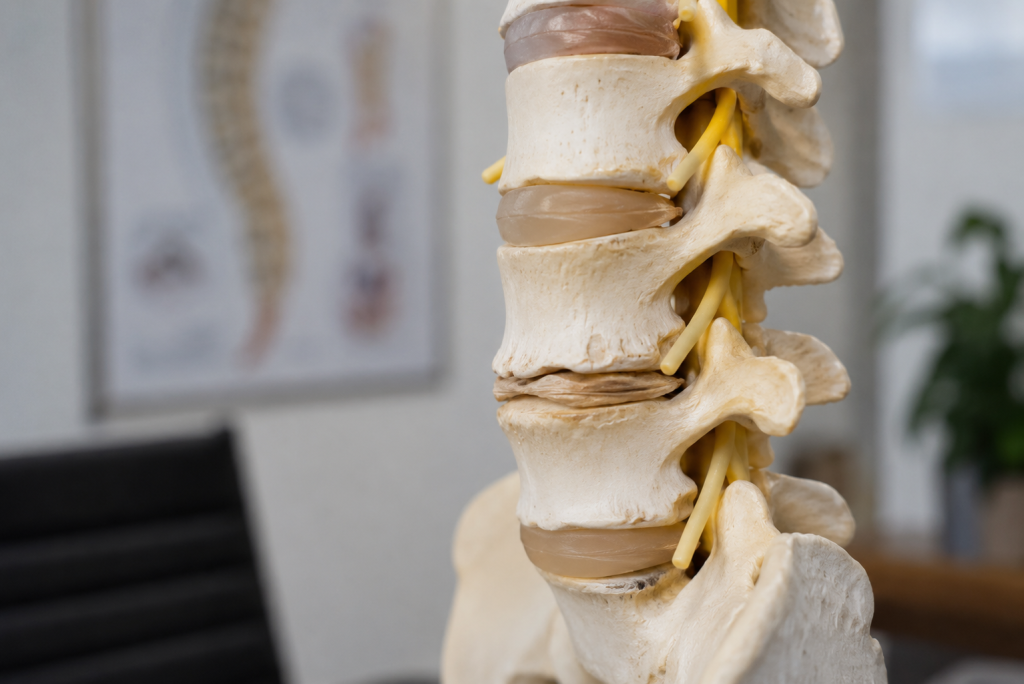
Degenerative disc disease describes wear-related changes in the discs between the vertebrae. Despite the name, it is not a disease in the usual sense. Spinal discs naturally lose water, flexibility, and height over time, although the amount and pace of change vary from person to person.
A disc can become thinner, develop small tears, or bulge beyond its usual border. As disc height decreases, nearby joints and the openings used by spinal nerves may also be affected. These changes can occur in the cervical spine in the neck or the lumbar spine in the lower back.
Disc degeneration does not always cause pain. Many adults have degenerative findings on imaging and continue to live active, comfortable lives. A diagnosis becomes clinically useful only when the location and type of change help explain the patient’s symptoms and function.
When symptoms do occur, the pain may come from the disc itself, nearby joints, inflammation, abnormal movement at a spinal segment, or pressure on a nerve. More than one structure may be involved.
Symptoms and Causes of Disc Degeneration
- Ongoing or recurring low back pain
- Neck pain and stiffness
- Pain that worsens with sitting, bending, lifting, twisting, or other specific movements
- Pain that improves when position or activity changes
- Radiating arm or leg pain when a nerve is irritated or compressed
- Numbness, tingling, or weakness when nerve function is involved
How Doctors Connect MRI Findings to Symptoms
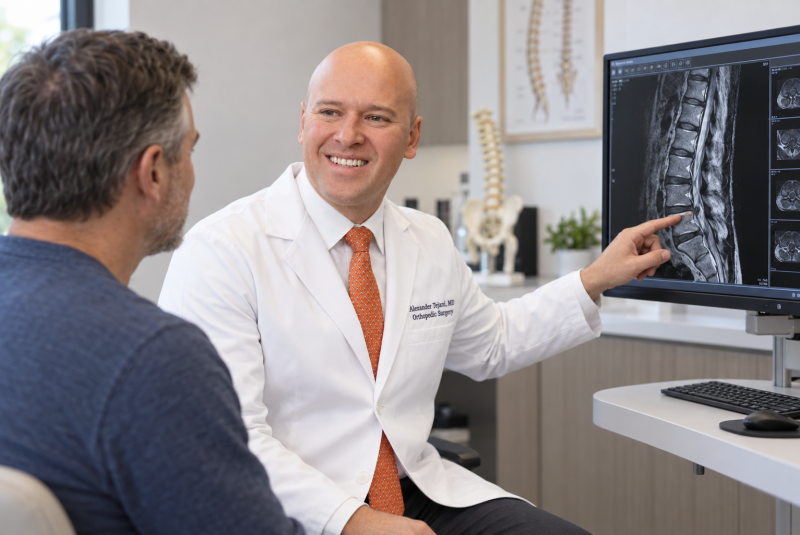
An MRI can show disc dehydration, height loss, bulging, herniation, endplate changes, and narrowing around a nerve. It can also show changes at several levels at once. The central question is not whether degeneration exists; it is whether a specific finding accounts for the patient’s pain or neurological symptoms.
The pattern must match. A finding on the right side should not automatically be blamed for symptoms isolated to the left. A neck finding should match the arm or hand pattern it is expected to affect. The same principle applies to lumbar findings and leg symptoms.
The examination adds context. Strength, sensation, reflexes, movement, balance, and the positions that reproduce pain help determine whether a disc or nerve is likely to be involved. Mechanical back or neck pain may require a different approach from clear nerve compression.
Prior treatment provides evidence. The response to physical therapy, medication, injections, and previous procedures can narrow the list of likely pain sources. A brief but clear response to a targeted procedure may offer useful information even when it is not a permanent solution.
CPS reviews available imaging in the context of symptoms and treatment history. An MRI report alone does not establish that degeneration is painful, and it does not determine whether surgery is needed. If the scan is outdated or symptoms have changed, additional imaging may be recommended for a specific reason.
Treatment Options for Degenerative Disc Disease
Degenerative disc disease treatment is based on the symptoms that need to change: pain, nerve irritation, limited movement, weakness, or loss of function. Care often begins without surgery.
Physical therapy and activity planning. A program may focus on mobility, trunk or neck strength, body mechanics, and a gradual return to useful activity. Treatment should be adjusted to the location of the disc changes and the way symptoms behave.
Medication and pain management. Appropriate medication may reduce pain or inflammation. When a nerve, joint, or disc is suspected, targeted injections or other interventional procedures may help treat symptoms and provide diagnostic information.
CPS provides interventional pain management as part of a broader spine-care pathway, so the response can inform what happens next.
When surgery enters the discussion. A spine surgery consultation may be appropriate when degeneration contributes to clearly defined nerve compression, spinal instability, deformity, or persistent disabling symptoms after appropriate non-surgical care. The proposed procedure should address a specific structural problem, not the word “degeneration” on an MRI.
Depending on the problem, treatment may focus on decompressing a nerve, stabilizing an unstable level with fusion, or using a motion-preserving approach in a carefully selected patient. Some procedures may be performed through a minimally invasive spine surgery approach, but the safest and most effective method depends on the anatomy and goals.
Frequently Asked Questions About Degenerative Disc Disease
Is degenerative disc disease the same as arthritis?
No. Degenerative disc disease affects the discs between the vertebrae. Arthritis affects joints, including the facet joints in the spine. Disc height loss can increase stress on nearby joints, so both conditions may occur together and contribute to similar symptoms.
Does degenerative disc disease always require surgery?
No. Many people have disc degeneration without symptoms, and many symptomatic cases can be managed with physical therapy, medication, activity changes, and targeted pain management. Surgery is considered only when there is a defined problem it is likely to improve.
What does degenerative disc disease feel like?
It may cause an aching or sharp pain in the neck or lower back that changes with movement or position. If a nerve is affected, pain, tingling, numbness, or weakness may travel into an arm or leg.
What treatments are used for degenerative disc disease?
Treatment may include physical therapy, medication, activity planning, injections, diagnostic pain procedures, and, in selected cases, spine surgery. The plan depends on whether symptoms come from a disc, joint, nerve, instability, or a combination of structures.
When is spinal fusion considered for degenerative disc disease?
Fusion may be considered when a painful or unstable spinal segment has been clearly identified and appropriate non-surgical treatment has not restored acceptable function. It may also be used when decompression would leave the spine unstable. Disc degeneration on MRI alone is not enough to justify fusion.
Does an MRI confirm that disc degeneration is causing my pain?
No. MRI confirms structural changes, but those findings must be compared with the location of symptoms, physical examination, neurological findings, and response to previous treatment. Some degenerative findings are incidental.
When should degenerative disc symptoms be evaluated urgently?
Seek prompt medical assessment for sudden or rapidly worsening weakness, loss of bowel or bladder control, saddle numbness, major changes in walking or coordination, fever with severe spinal pain, or symptoms after significant trauma.