What Is Back Pain?
Back pain is one of the most common reasons people seek medical evaluation, but it is rarely a single condition. It can develop in the lower back, mid-back, or upper spine, and each area behaves differently.
For some, it presents as stiffness or a dull ache that builds over time. For others, it appears as a sharp, limiting pain tied to movement. In many cases, it starts intermittently and becomes more consistent.
The spine carries load, supports movement, and absorbs stress throughout the day. That constant demand makes it vulnerable to both gradual wear and more specific structural problems.
Back pain is not a diagnosis. It is a signal. The focus is understanding what is driving it.
What Causes Back Pain?

Back pain can come from a range of sources, and in many cases, more than one factor is involved.
Common causes include:
- Muscle and ligament strain, often related to lifting, posture, or repetitive movement
- Disc-related issues, including bulging or herniated discs that may irritate nearby nerves
- Degenerative changes, where discs and joints wear over time and alter how the spine moves
- Spinal stenosis, where narrowing around the nerves leads to pressure and symptoms
- Joint-related pain, including facet joints or the sacroiliac joint
- Repetitive stress or prolonged sitting, which gradually increases strain on the spine
In some situations, the trigger is obvious. In others, the cause develops over time and only becomes noticeable when symptoms reach a certain point.
Symptoms of Back Pain
Back pain does not present the same way for everyone. The pattern of symptoms often provides important clues.
Patients may experience:
A persistent ache or tightness that worsens with activity
Sharp pain with bending, lifting, or twisting
Stiffness that limits movement, especially after sitting or sleeping
When nerves are involved, symptoms often change:
Pain that travels into the leg or buttock
Tingling or numbness along a specific path
A burning or electric sensation
Weakness in the leg or foot
Pain can also shift over time. It may improve temporarily, worsen with certain movements, or change location. These patterns are often more useful than the intensity of pain alone.
Treatment Options for Back Pain

Treatment depends on what is causing the pain and how it has responded to previous care. There isn’t a single approach that applies to every patient. The focus is on identifying where you are in the process and choosing the next step based on that, rather than repeating what has already been done.
Early and Non-Surgical Care
For some patients, symptoms are still in an earlier stage or have not been fully addressed with basic treatment. In these cases, more conservative approaches may still be appropriate.
This may include:
- Physical therapy or guided exercise, focused on improving movement, stability, and support around the spine
- Short-term medication use, such as anti-inflammatory medication to reduce irritation
- Activity modification, especially when certain movements or positions are consistently aggravating symptoms
These approaches are often the starting point, but they are not always the end of the process, particularly when symptoms continue.
Interventional Pain Management
When symptoms persist or return despite early treatment, more targeted approaches are often needed. These are used to reduce inflammation, improve function, and help confirm the source of pain.
Common options include:
- Epidural steroid injections, used when inflammation around a nerve is contributing to pain that may travel into the leg
- Facet joint injections, which target the small joints in the spine that can become irritated or arthritic
- Radiofrequency ablation, used when those joints are confirmed as the source of pain and longer-lasting relief is needed
- Sacroiliac (SI) joint injections, used when pain originates from the joint connecting the spine and pelvis
- Basivertebral nerve ablation, used in specific cases where pain originates within the vertebra itself
- Disc-focused procedures, used when the disc itself is contributing to symptoms
These treatments are not only therapeutic. In many cases, they also provide important diagnostic information by showing how the body responds.
Minimally Invasive Spine Procedures
For patients with confirmed structural issues, minimally invasive procedures may be considered.
These approaches focus on addressing the problem directly while limiting disruption to surrounding tissue. They are often used when:
- Imaging shows a specific source of compression or instability
- Symptoms have not improved with non-surgical treatment
- Pain is affecting daily function or mobility
The exact procedure depends on the underlying issue, but the goal remains the same: address the cause with as little unnecessary intervention as possible.
When Surgery Becomes Part of the Conversation
Surgery is not the starting point. It becomes part of the discussion when:
- Symptoms persist despite multiple types of treatment
- Imaging confirms a structural issue
- Nerve-related symptoms such as weakness or radiating pain are present
Common surgical options may include:
- Discectomy, to relieve pressure from a herniated disc
- Spinal fusion, when instability or advanced degeneration is present
- Other spine procedures, depending on the condition and location
Because CPS evaluates both pain and spine conditions, patients can be guided toward surgical consultation when appropriate without starting over elsewhere.
Most patients do not fit into a single category. Some are early in the process, while others have already tried multiple treatments. The goal is to identify where you are and move forward with a more targeted approach, rather than continuing with the same cycle of temporary relief.
FAQs for Back and Spine Pain
How do I know if my back pain needs to be evaluated?
Back pain that improves within a few days is often related to strain. When it lasts longer than a few weeks, keeps returning, or begins to change in pattern, it’s worth taking a closer look.
Pain that travels into the leg, causes numbness or tingling, or affects strength usually points to something involving the spine or nerves. That type of pattern rarely resolves on its own without understanding what is driving it.
Is all back pain related to the spine?
Not always. Muscle strain, posture, and joint irritation can all contribute to back pain. That said, persistent or recurring symptoms often involve the spine in some way, whether through discs, joints, or nerve pathways.
Part of the evaluation is determining whether the pain is localized or connected to something deeper.
What makes back pain worse over time?
Back pain often worsens when the underlying issue is not addressed. This can include:
Continuing activities that place stress on the spine
Long periods of sitting without proper support
Repeating treatments that provide only temporary relief
In some cases, structural changes such as disc degeneration or narrowing around nerves continue to progress, which changes how symptoms behave.
When should imaging like an MRI be considered?
Imaging is usually considered when symptoms persist, worsen, or begin to involve the legs or nerves.
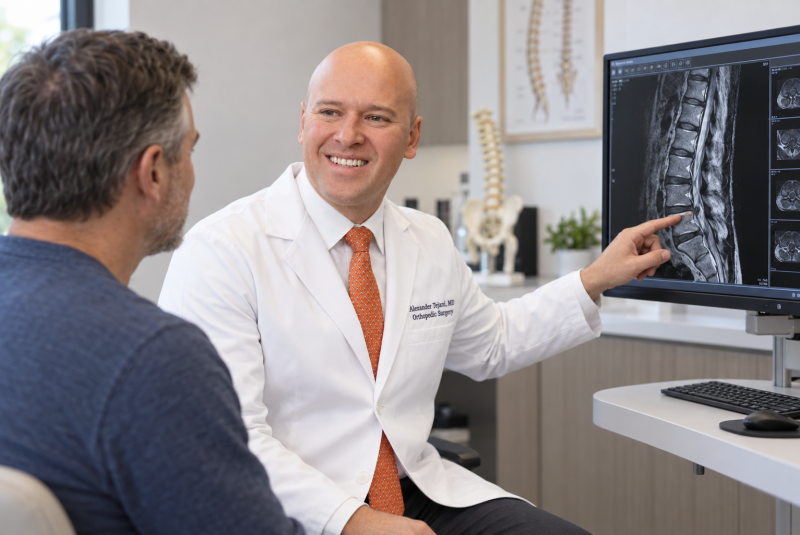
An MRI helps show whether a disc, joint, or nerve is involved and provides more direction for what to do next. It becomes especially important when previous treatment has not provided clear results.
Will my back pain go away on its own?
Some cases improve, particularly when caused by short-term strain. When pain continues beyond a few weeks or keeps returning, it often means the underlying issue has not been fully addressed.
At that point, waiting it out tends to delay progress rather than resolve the problem.
Will I need surgery for back pain?
Most patients do not. Surgery is considered only when:
Symptoms continue despite multiple types of treatment
Imaging shows a clear structural issue
Nerve-related symptoms are present or progressing
Even then, it’s part of a broader discussion, not the first step.
Why does my back pain come and go?
This usually means the underlying issue is still present but responds differently depending on activity, posture, or inflammation.
For example, a disc or joint problem may feel manageable on some days and flare up on others. That pattern often indicates something mechanical or structural that hasn’t been fully resolved.
What should I do if I’ve already tried treatment and it didn’t work?
That’s one of the most common situations we see.
The next step is not simply trying something new at random. It’s understanding why previous treatment didn’t work. That may involve reviewing prior care,